
TagMaster Site-Directed Mutagenesis Kit
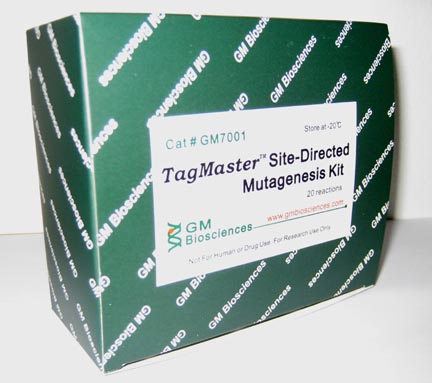
Easily insert or switch any tag into your gene. Powered by our proprietary technology, this kit delivers the highest efficiency and fidelity for a wide range of site-directed mutagenesis applications.
Overview
The TagMaster Kit provides a rapid, efficient, and accurate method for large-fragment mutagenesis in a single reaction, optimized for plasmids up to 10kb. In addition to point mutations, the kit achieves the highest accuracy and efficiency for various modifications, including insertions/substitutions (~60 bp), deletions (~660 bp), and multi-site mutations (two sites).
It is the first kit of its kind that can insert or switch tags (such as 6xHis, Myc, Flag, HA, V5) into a gene in a simple, single reaction. It also allows for easy construction of CRISPR/Cas9 expression plasmids by switching or inserting guide RNA sequences in one reaction.
Key Features
- Powerful & Versatile
- Insertion/substitution (1-60 bp)
- Deletion (1-660 bp)
- Multi-site mutations (2 sites)
- Insert/switch tags (6xHis, Myc, Flag, HA, V5, etc.)
- Insert/switch sgRNA sequences in CRISPR/Cas9 plasmids
- Suitable for plasmids up to 10 kb
- Efficient: Achieve 80% to >99% mutation rates.
- Accurate: A high-fidelity enzyme blend and a linear DNA amplification (non-PCR) procedure ensure accuracy.
- Fast and Simple: An easy 2-step protocol with a 1-2 hour reaction time.

Applications
- Protein Function Studies: Investigate the role of specific amino acids.
- Gene Regulation Analysis: Modify promoter or enhancer elements.
- Enzyme Engineering: Optimize catalytic activity or substrate specificity.
- Protein Tagging: Add epitope tags for detection, purification, or localization studies.
Protocol Overview
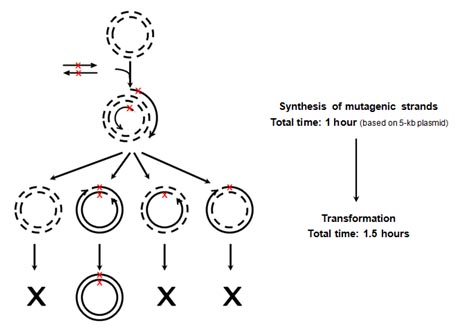
The TagMaster protocol is simple and streamlined. It involves a PCR reaction with specially designed primers, followed by a DpnI digestion to remove the parental template DNA, and transformation into competent E. coli cells. The entire process is rapid and reliable.
Experimental Data
The TagMaster Mutagenesis Kit demonstrates unparalleled efficiency. As shown in Fig 1, mutation rates of 99.4% and 98.7% were achieved for a 2 bp substitution and an 18 bp (6xHis tag) insertion, respectively. This technology circumvents the limitations of traditional restriction enzyme-based cloning, enabling you to easily obtain different tags for a gene. As shown in Fig 2, various tags (6xHis, HA, Myc+Flag, Myc, Flag) were successfully inserted into a 7.4 kb plasmid. The kit has also successfully deleted the GST Gene (660 bp) from an expression plasmid. Furthermore, the proprietary TagMaster competent cells included in the kit achieve a significantly higher mutagenesis rate than other cells, such as DH5α (Fig 3).
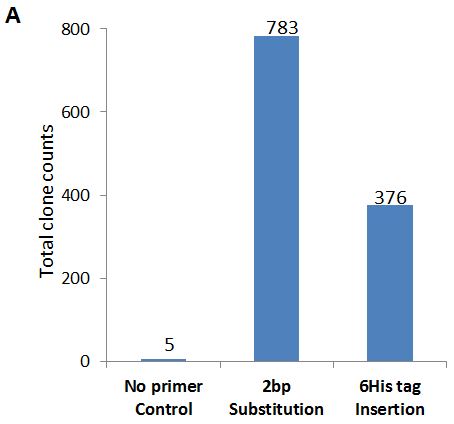
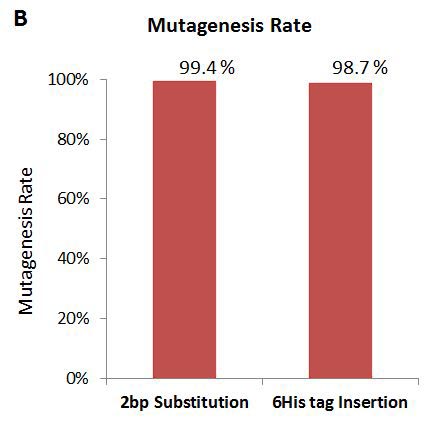
Fig 1. Unparalleled mutagenesis rate achieved by TagMaster Site-Directed Mutagenesis Kit. Three mutagenesis reactions were performed under conditions of 95°C for 5min, followed by 22 cycles of (95°C 20sec, 60°C 10sec, 68°C 2min). Without any treatment, the reaction products were directly transformed into TagMaster competent cells and spread onto LB plates. Clone number in each plate were counted as shown in panel A. The mutagenesis rates were calculated and results are shown in panel B. Please click the figure for details.
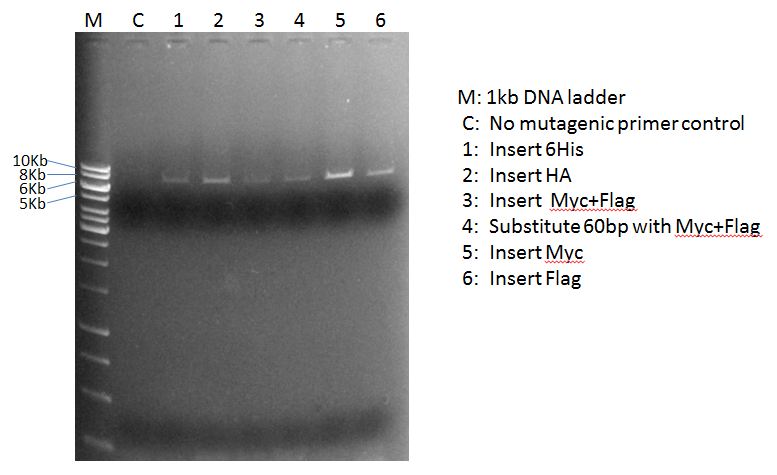
Fig 2. Successful insertion of different tags (6xHis, HA, Myc+Flag, Myc, Flag) into a 7.4kb plasmid. The Mutagenesis reactions were performed under conditions of 95°C 5min, 20cycles of (95°C 20sec, 60°C 10sec, 70°C 3min20sec). The reaction products were run in 1% agrose gel (as shown above). The products were then directly transformed into TagMaster competent cells. The insertion of tags was verified by sequencing. The successful rates of all 6 mutagenesis reactions were 82%~91%. Please click the figure for details.
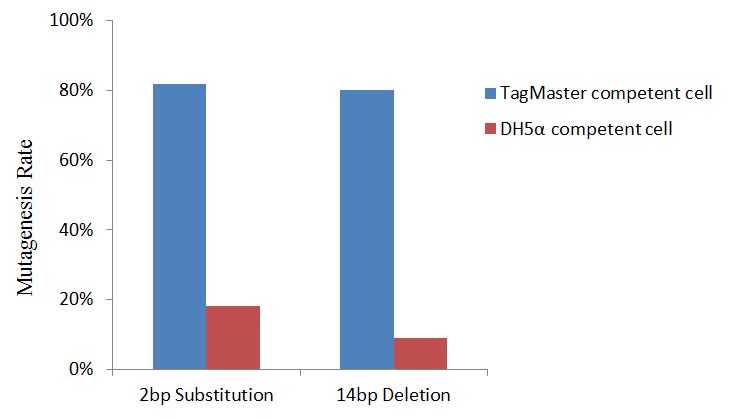
Fig 3. TagMaster competent cells achieve significantly higher mutagenesis efficiency than DH5α competent cells. Please click the figure for details.